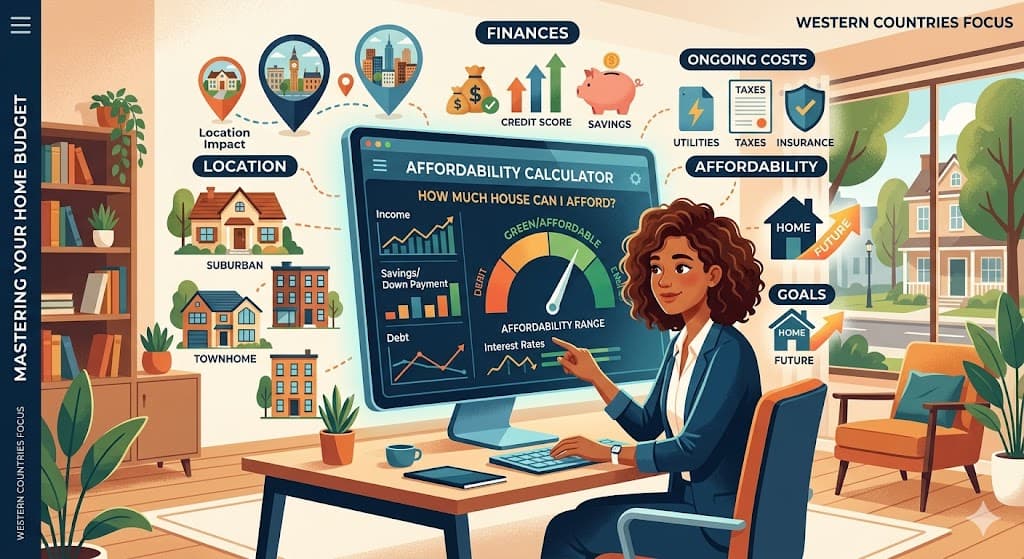

The 28/36 rule is a mortgage affordability guideline that says your monthly housing costs should not exceed 28% of your gross monthly income, and your total monthly debt payments s
The 28/36 rule is a mortgage affordability guideline that says your monthly housing costs should not exceed 28% of your gross monthly income, and your total monthly debt payments should not exceed 36% of your gross monthly income. Lenders in the US use this rule to evaluate whether a borrower can comfortably manage a mortgage without financial strain.
What Is the 28/36 Rule for Mortgages? The Complete Guide to Home Affordability in 2026
Imagine this: You've found the perfect home in Austin, Texas. Three bedrooms, a great school district, and a backyard your kids will love. The asking price is $420,000. Your realtor says you can probably swing it. Your gut says maybe. But your bank account? That's where things get complicated.
This is exactly where millions of American homebuyers find themselves every year — excited, hopeful, and deeply unsure about how much house they can actually afford. Overspend, and you risk becoming "house poor," stretching every paycheck just to cover the mortgage. Underspend, and you might miss out on the home that checks all your boxes.
There's a simple, time-tested rule that mortgage lenders, financial advisors, and banks have used for decades to answer this question with clarity: the 28/36 rule.
In this guide, you'll learn exactly what the 28/36 rule is, how to apply it to your salary, whether it's realistic in today's market, and how to use it to make the smartest mortgage decision of your life.
What Is the 28/36 Rule?
The 28/36 rule is a mortgage affordability guideline stating that your monthly housing costs should not exceed 28% of your gross monthly income, and your total monthly debt payments — including housing — should not exceed 36% of your gross monthly income. Lenders use this rule to evaluate mortgage eligibility and financial risk.
Understanding the 28/36 Rule in Depth
The 28/36 rule has two distinct parts, and both matter equally when a lender evaluates your mortgage application.
The 28% Front-End Ratio (Housing Ratio)
The first number — 28% — is called the front-end ratio or housing ratio. It represents the maximum percentage of your gross monthly income that should go toward all housing-related costs, including:
- Monthly mortgage principal and interest payments
- Property taxes
- Homeowner's insurance (HOI)
- HOA fees (if applicable)
- Private mortgage insurance or PMI (if your down payment is less than 20%)
This is sometimes referred to as the PITI (Principal, Interest, Taxes, Insurance) ratio.
The 36% Back-End Ratio (Total Debt Ratio)
The second number — 36% — is called the back-end ratio or total debt-to-income ratio. It covers everything in the front-end ratio PLUS all other recurring monthly debt obligations, such as:
- Student loan payments
- Car loan payments
- Credit card minimum payments
- Personal loan payments
- Child support or alimony payments
The back-end ratio gives lenders a complete picture of your financial obligations relative to your income.
The 28/36 Rule Formula and Breakdown
| Rule | Percentage | What It Covers |
|---|---|---|
| 28% Rule (Front-End) | Housing Costs | Mortgage principal + interest, property taxes, homeowner's insurance, PMI, HOA fees |
| 36% Rule (Back-End) | Total Debt | All housing costs + student loans, car loans, credit card minimums, personal loans |
The Formulas:
- Maximum Monthly Housing Payment = Gross Monthly Income × 0.28
- Maximum Total Monthly Debt = Gross Monthly Income × 0.36
These are the numbers your lender will actually calculate when reviewing your mortgage application. If either ratio comes in too high, you may face rejection or be offered a smaller loan amount.
28/36 Rule Example — Using a $100,000 Salary
Let's walk through the most commonly searched example: someone earning $100,000 per year.
Step 1: Calculate Gross Monthly Income
$100,000 ÷ 12 = $8,333/month
Step 2: Apply the 28% Rule
$8,333 × 0.28 = $2,333/month maximum housing cost
This means your mortgage payment, property taxes, insurance, and HOA fees combined cannot exceed $2,333 per month.
Step 3: Apply the 36% Rule
$8,333 × 0.36 = $3,000/month maximum total debt
If you already have $500/month in car payments and $300/month in student loans, your total existing debt is $800/month. Subtract that from $3,000, and your available mortgage budget drops to:
$3,000 − $800 = $2,200/month
So in this real-world example, your actual mortgage limit — after accounting for your existing debts — is $2,200/month, not $2,333/month. The back-end ratio is the binding constraint here, which is often the case for many borrowers.
What Does $2,200/Month Buy You?
At a 7% mortgage interest rate on a 30-year fixed loan, $2,200/month in principal and interest supports a loan of approximately $330,000–$350,000. After a 20% down payment, that means you could afford a home in the $410,000–$440,000 range.
Use our mortgage calculator to run your exact numbers based on current interest rates.
How Much House Can I Afford? Salary-Based Breakdowns
One of the most important questions any homebuyer asks is how much house their salary can support. Here's a salary-by-salary breakdown using the 28/36 rule:
How Much House Can I Afford With a $50,000 Salary?
Gross Monthly Income: $4,167
- 28% Housing Limit: $1,167/month
- 36% Total Debt Limit: $1,500/month
With no other debts, your maximum mortgage payment is $1,167/month. At 7% over 30 years, that supports a loan of roughly $175,000, meaning a home purchase price of around $218,000 with a 20% down payment.
This is challenging in most major US metros but very workable in affordable markets in the Midwest, South, or rural areas. Getting a side income stream, paying down existing debts, or saving for a larger down payment can help stretch this further.
How Much House Can I Afford With an $80,000 Salary?
Gross Monthly Income: $6,667
- 28% Housing Limit: $1,867/month
- 36% Total Debt Limit: $2,400/month
Your maximum mortgage payment is $1,867/month with zero other debts. At today's rates, this translates to approximately $280,000 in loan amount, or a purchase price of around $350,000 with 20% down.
How Much House Can I Afford With a $100,000 Salary?
Gross Monthly Income: $8,333
- 28% Housing Limit: $2,333/month
- 36% Total Debt Limit: $3,000/month
This is the sweet spot for many buyers. With minimal existing debt, you can afford a loan of approximately $330,000–$350,000, putting your home-buying range at $410,000–$440,000 with 20% down.
Want to see your exact numbers instantly? Use our house affordability calculator to calculate in seconds.
How Much House Can I Afford With a $150,000 Salary?
Gross Monthly Income: $12,500
- 28% Housing Limit: $3,500/month
- 36% Total Debt Limit: $4,500/month
At $3,500/month in mortgage payments and current rates, you can comfortably borrow around $525,000, which means a purchase price of $655,000+ with 20% down. This opens doors in most US metropolitan markets.
How Much House Can I Afford With a $200,000 Salary?
Gross Monthly Income: $16,667
- 28% Housing Limit: $4,667/month
- 36% Total Debt Limit: $6,000/month
At this income level, you can borrow approximately $700,000, meaning a home purchase price of $875,000+ with 20% down. You're now in the market for high-end suburban homes or entry-level luxury properties in most major US cities.
Summary Table:
| Annual Salary | Max Monthly Housing (28%) | Max Total Debt (36%) | Estimated Home Price (20% Down, 7% Rate) |
|---|---|---|---|
| $50,000 | $1,167 | $1,500 | ~$218,000 |
| $80,000 | $1,867 | $2,400 | ~$350,000 |
| $100,000 | $2,333 | $3,000 | ~$440,000 |
| $150,000 | $3,500 | $4,500 | ~$655,000 |
| $200,000 | $4,667 | $6,000 | ~$875,000 |
Note: Home prices are estimates based on 7% interest rate, 30-year term, and 20% down payment. Actual prices vary based on current rates, taxes, insurance, and local market conditions.
Use the 28/36 Rule Calculator to Check Your Affordability
Rather than doing the math manually every time, use a dedicated calculator to get instant, accurate results.
Our 28/36 rule calculator based on salary lets you:
- Enter your annual or monthly gross income
- Input your existing monthly debt payments
- Instantly see your maximum housing budget under both the 28% and 36% rules
- Understand your home loan eligibility in 2 minutes
You can also use our home loan EMI calculator to figure out what your monthly payment would look like on any given loan amount, or our EMI calculator for a broader view across different loan types.
👉 Check your mortgage eligibility right now — it takes less than 2 minutes.
Is the 28/36 Rule Based on Gross or Net Income?
This is one of the most frequently asked questions about this rule — and the answer is clear:
The 28/36 rule is based on your gross income — that is, your income before taxes and deductions.
Why gross income? Because lenders don't have a standardized way to compare take-home pay across borrowers. Tax situations vary widely based on filing status, deductions, retirement contributions, and more. Gross income is consistent, verifiable, and easy to document through pay stubs, tax returns, or W-2 forms.
What this means practically: If you earn $100,000/year, the rule applies to $8,333/month — not your actual take-home pay of, say, $5,800/month after federal taxes, state taxes, Social Security, and 401(k) contributions.
This is both the strength and the weakness of the rule. Lenders can consistently apply it, but your real-world budget is based on your take-home pay — which may be significantly lower. A person earning $100,000 in a high-tax state like California might take home only $64,000–$68,000/year, making a mortgage based on gross income feel tight in practice.
Does the 28/36 Rule Include Utilities?
No — the 28/36 rule does not include utilities.
When lenders calculate your front-end ratio, they count:
- Mortgage principal and interest
- Property taxes
- Homeowner's insurance
- HOA dues
- PMI (if applicable)
Utilities — electricity, gas, water, internet, trash — are not part of the calculation. Neither are maintenance and repair costs, which can add another 1–2% of your home's value per year.
However, for your personal budgeting purposes, utilities absolutely matter. A large home may come with electric bills of $200–$400/month. An older home might need $500–$1,000/year in unexpected repairs. A community with no public transit could add $300–$600/month in commuting costs.
The 28/36 rule is a lender tool for loan eligibility — not a complete personal finance budget. Smart buyers add 5–10% on top of the lender's front-end calculation to account for real-world housing costs before deciding what they can comfortably afford.
For a full picture of your monthly payments, try our payment calculator and factor in utilities and maintenance separately.
Is the 28/36 Rule Realistic in 2025?
This is where the conversation gets interesting — and polarizing.
The Case For the 28/36 Rule
The rule has been the backbone of responsible lending for decades. It emerged from data showing that borrowers who kept housing costs below 28% of income were significantly less likely to default. Banks, the FHA, Fannie Mae, and Freddie Mac all reference variants of this rule in their underwriting standards. It's conservative, protective, and straightforward.
Pros:
- Simple and easy to apply
- Reduces risk of overextending your finances
- Helps you maintain cash flow for savings, emergencies, and retirement
- Protects your debt-to-income ratio for future borrowing
The Case Against the Rule in Today's Market
Here's the hard truth: in 2025, applying the 28/36 rule strictly makes homeownership mathematically impossible in many US markets.
The median home price in the United States exceeded $400,000 in 2024. In cities like San Francisco, Seattle, Boston, and New York, median prices range from $700,000 to well over $1 million. Even at $100,000/year — a salary that puts you in the top 30% of US earners — the 28% rule limits your mortgage payment to about $2,333/month, which might only support a loan of $300,000–$350,000 at current interest rates.
Cons:
- Too restrictive for high-cost-of-living markets
- Based on gross income, not take-home pay
- Doesn't account for differences in tax burden by state
- Doesn't reflect modern debt realities (student loans, etc.)
- Ignores wealth-building benefits of home equity
What Reddit Says About the 28/36 Rule
Browsing discussions on 28/36 rule on communities like r/personalfinance and r/FirstTimeHomeBuyer reveals a consistent theme: most first-time buyers in coastal US markets simply cannot meet the 28% threshold without a massive down payment or a high household income.
A common comment goes something like: "We were at 35% for housing alone on our combined income of $130k and we bought anyway. Three years later, we're fine." Many buyers stretch beyond the rule with good outcomes — but the risk is real if income drops, interest rates rise, or unexpected expenses hit.
The consensus from financially savvy communities: use the rule as a target, not a rigid ceiling, and build in an emergency fund before stretching past it.
28/36 Rule vs Other Affordability Rules
| Rule | What It Means | Best Used For |
|---|---|---|
| 28/36 Rule | Housing ≤ 28% of gross income; total debt ≤ 36% | Mortgage qualification, lender evaluation |
| 30% Rule | Housing (rent or mortgage) ≤ 30% of gross income | Basic rent affordability for renters |
| 50/30/20 Rule | 50% needs, 30% wants, 20% savings/debt | Overall personal budget planning |
| 43% DTI Rule | Total debt ≤ 43% of gross income | FHA and conforming loan hard limit |
| 25% Rule | Mortgage ≤ 25% of take-home pay | Conservative homebuying approach |
The 28/36 rule is specifically designed for mortgage lending decisions. The 30% rule is more commonly applied to renting. The 50/30/20 rule is a holistic budgeting framework. Many financial planners recommend using the 28/36 rule for loan eligibility and then applying the 25%-of-take-home-pay test for real-world comfort.
Mortgage Affordability Rules by Country
United States
The 28/36 rule is standard across US lending. The Consumer Financial Protection Bureau (CFPB) uses a 43% back-end DTI as the hard ceiling for qualified mortgages. Fannie Mae and Freddie Mac allow up to 45–50% DTI in some cases, but anything beyond 36% is considered elevated risk.
United Kingdom
UK mortgage lenders typically use income multiples rather than percentage-based rules. Most lenders offer loans at 4 to 4.5 times your annual salary. The Financial Conduct Authority (FCA) mandates affordability stress tests to ensure borrowers can handle interest rate increases. The concept aligns with the 28/36 rule in spirit — preventing over-leverage — but the mechanics differ.
Canada
Canadian mortgage rules follow the Gross Debt Service (GDS) ratio and Total Debt Service (TDS) ratio, which are nearly identical to the US 28/36 framework. The CMHC (Canada Mortgage and Housing Corporation) recommends:
- GDS ≤ 32% (similar to the US 28% front-end)
- TDS ≤ 44% (slightly more generous than the US 36%)
Stress tests introduced in 2021 require Canadian borrowers to qualify at a rate 2% higher than their actual rate, making affordability more conservative in practice.
Common Mistakes Homebuyers Make With the 28/36 Rule
1. Using Net Income Instead of Gross
The rule applies to gross income. Using your take-home pay will make your budget look smaller than what lenders actually expect — while using gross gives a number that may be tighter in real life than it appears on paper.
2. Ignoring Existing Debts
Many buyers focus only on the 28% housing limit and forget that the 36% total debt cap is often the binding constraint. If you have a car payment, student loans, and credit card minimums, your effective mortgage budget can be dramatically lower than the 28% calculation suggests.
Use our debt calculator to total up your current monthly debt obligations before applying for a mortgage.
3. Forgetting Property Taxes and Insurance
The 28% doesn't just cover your mortgage payment — it must include property taxes and homeowner's insurance. In high-tax states like New Jersey, Illinois, or Texas, property taxes alone can add $400–$800/month to your housing cost, significantly reducing how much you can borrow.
4. Not Accounting for Rate Changes on ARMs
If you're taking an adjustable-rate mortgage (ARM), your payment can increase after the initial fixed period. Qualifying under the 28/36 rule at the initial rate doesn't guarantee affordability when the rate adjusts. Always stress-test your budget at 2–3% higher rates.
5. Treating Lender Approval as Personal Affordability
Just because a lender approves you for $500,000 doesn't mean $500,000 is comfortable for you. Lender qualification is the ceiling, not the target. Build your budget from the bottom up using your actual take-home pay and real-world expenses.
Take Action: Check Your Mortgage Affordability Now
Ready to see exactly where you stand? Here are the tools you need:
For mortgage calculations:
- Mortgage Calculator — Calculate your monthly payment for any home price, rate, and term
- House Affordability Calculator — Find your maximum home price based on income and debts
- Home Loan EMI Calculator — See your exact EMI breakdown for any loan amount
For your income and debt picture:
- Annual Income Calculator — Convert hourly/weekly pay to annual and monthly gross
- Salary to Hourly Calculator — Work out your effective hourly rate
- Debt Calculator — Total your monthly obligations before applying
For long-term financial planning:
- Compound Interest Calculator — See how your down payment savings grow over time
- 401(k) Calculator — Make sure you're not sacrificing retirement for a home
- Refinance Calculator — Evaluate if refinancing makes sense once you've bought
👉 Compare mortgage options and check your eligibility in 2 minutes — no account needed.
28/36 Rule — Frequently Asked Questions
Why does the 28/36 rule exist?
The 28/36 rule exists to protect both borrowers and lenders from the consequences of over-leveraging. Historical mortgage default data shows that borrowers who keep housing costs below 28% of gross income have substantially lower default rates. Lenders use it to ensure loans are issued responsibly, and it became the industry standard for underwriting through the 20th century.
Is the 28/36 rule a good standard?
For most borrowers in most markets, yes — it's a solid starting framework. It builds in a buffer for emergencies, allows room for retirement savings, and keeps your debt manageable. However, in high-cost markets like New York, Los Angeles, or San Francisco, strict adherence may make homeownership impossible. Many financial advisors suggest using it as a guideline while also assessing your full monthly cash flow.
What is the maximum mortgage payment allowed under this rule?
Your maximum monthly housing payment is 28% of your gross monthly income. On a $75,000 salary, that's $1,750/month. On $120,000, it's $2,800/month. The binding constraint is whichever figure is lower — the 28% housing limit or the result of the 36% total debt cap minus your existing debts.
Can I get a mortgage if I exceed the 36% threshold?
Yes, in many cases. FHA loans allow DTI ratios up to 43%, and some conventional loans backed by Fannie Mae or Freddie Mac allow up to 45–50% in exceptional cases. However, exceeding 36% typically means you'll face higher interest rates, stricter documentation requirements, or a lower maximum loan amount. It also increases your financial risk if income disruption occurs.
Does the 28/36 rule use gross or net income?
Gross income — always. Lenders use pre-tax income because it's standardized and verifiable. Your take-home pay depends on too many personal variables (tax bracket, state, deductions, retirement contributions) to use as a universal benchmark. Be aware that qualifying on gross income and actually living comfortably on net income are two different things.
How do lenders actually use the 28/36 rule?
Lenders calculate both your front-end (housing) ratio and back-end (total debt) ratio using verified income from W-2s, tax returns, or bank statements. If either ratio exceeds the guideline, they may reduce the loan offer, ask for a larger down payment, or require a co-borrower. Some loan programs (FHA, VA, USDA) use slightly different DTI thresholds.
Is the 28% rule just for the mortgage payment?
No — the 28% front-end ratio covers the full PITI: Principal, Interest, Taxes, and Insurance. In some cases, HOA fees and PMI are also included. It's not just the base mortgage payment. This distinction matters a lot in areas with high property taxes or expensive insurance.
What if I have no other debt — can I go higher than 28%?
If you have zero recurring debt outside of housing, some lenders will approve mortgages where the housing cost approaches 35–38% of gross income, particularly for borrowers with strong credit scores (750+), substantial savings, or stable employment history. The guideline is flexible at the edges, but your real-world cash flow should always be your personal ceiling.
Does the rule apply to co-borrowers (couples)?
Yes — when two borrowers apply together, lenders combine their gross monthly incomes and debts. A couple earning $80,000 and $70,000 combined ($150,000) would have a gross monthly income of $12,500, giving them a housing limit of $3,500/month under the 28% rule.
Is the 28/36 rule the same as the debt-to-income ratio (DTI)?
They're closely related. DTI is the umbrella metric lenders use, and the 28/36 rule defines two specific DTI thresholds: 28% for housing (front-end DTI) and 36% for total debt (back-end DTI). When lenders talk about DTI for mortgage qualifying, they're usually referring to the back-end ratio — the 36% portion.
How has the 28/36 rule held up with rising home prices?
Poorly, in many markets. As home prices have surged faster than wages over the past decade, the 28% rule has become increasingly difficult to meet in high-demand cities. This is why many lenders have quietly expanded their acceptable DTI thresholds. The spirit of the rule — don't overextend — remains valid even if the specific percentages need contextual interpretation.
What's the best way to improve my 28/36 ratio before applying for a mortgage?
Three levers: increase income (additional income sources, raise, side hustle), reduce existing debt (pay off credit cards, car loans), or increase your down payment (reduces the loan amount and therefore the monthly payment). Running different scenarios through our mortgage house affordability calculator can show you exactly how much each lever moves your affordability.
Conclusion: Use the 28/36 Rule as Your Starting Point, Not Your Ceiling
The 28/36 rule is one of the most powerful and simple tools in personal finance. It gives you an objective, lender-aligned framework for answering the question every homebuyer wrestles with: how much house can I actually afford?
Used correctly, it prevents the single most common mistake in homebuying — letting emotion drive a financial decision that will affect your monthly cash flow for the next 30 years. But used rigidly, it can also cause paralysis in markets where housing costs have far outpaced income growth.
The smart approach: start with the 28/36 rule to understand your lender's perspective, then stress-test the numbers against your take-home pay, your existing debt load, your emergency fund, and your long-term savings goals. If you can comfortably meet both the 28% and 36% thresholds and still maintain your savings rate, you're in excellent shape. If you're pushing past 36%, proceed carefully — and make sure you have a financial cushion to absorb any income disruption.
Whatever your income level, the tools are right here:
- Mortgage Calculator to calculate monthly payments
- House Affordability Calculator to find your price range
- Home Loan EMI Calculator to see your exact installment breakdown
- Debt Calculator to understand your current debt picture
- Refinance Calculator to optimize after you've purchased
👉 Run your numbers now. Your dream home is worth planning for correctly.
This article is for informational and educational purposes only and does not constitute financial, legal, or mortgage advice. Mortgage eligibility is determined by lenders based on their specific criteria. Consult a licensed mortgage professional before making any borrowing decisions.