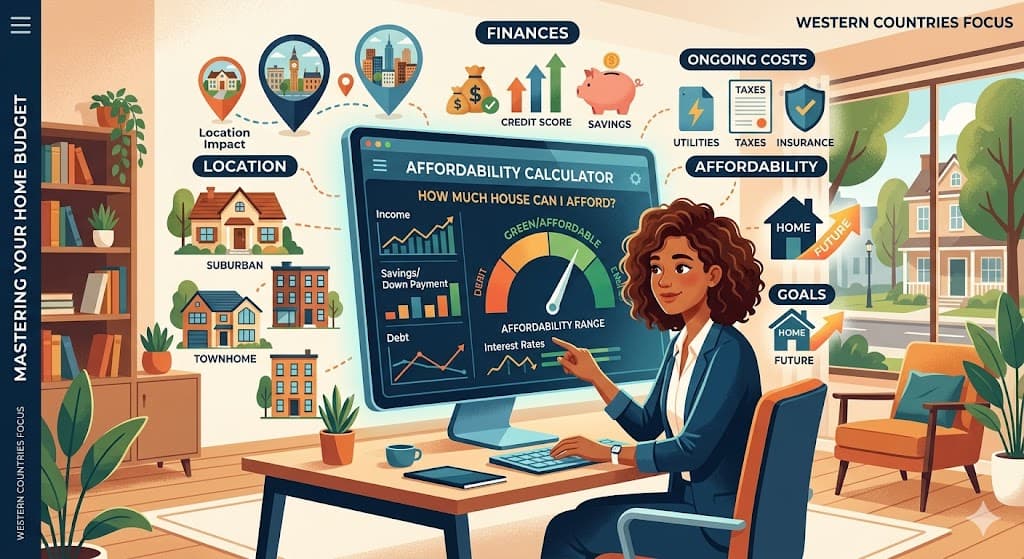
Find out how much house you can afford based on your salary. Use our free mortgage affordability calculator for instant results — no signup needed. Works for USA, UK, Canada, and A
A general rule is that you can afford a home worth 3 to 5 times your annual gross income. On a $60,000 salary, that's roughly $180,000 to $300,000. On a $100,000 salary, expect to afford between $300,000 and $500,000. Your credit score, debt, down payment, and interest rate will affect this number significantly.
Calculate Instantly — No Signup Required
Figuring out how much house you can afford doesn't have to be complicated. Whether you earn $50,000 or $300,000 a year, this guide gives you clear, salary-based numbers you can trust.
Use our free mortgage affordability calculator to get instant results tailored to your income, debt, and down payment — no account needed, no forms to fill out.
Works for: USA | UK | Canada | Australia
Quick Answer Table: How Much House Can I Afford by Salary?
| Annual Salary | Estimated Home Price (3–5x Rule) | Estimated Monthly Payment |
|---|---|---|
| $50,000 | $150,000 – $250,000 | $800 – $1,300 |
| $60,000 | $180,000 – $300,000 | $950 – $1,550 |
| $80,000 | $240,000 – $400,000 | $1,250 – $2,050 |
| $90,000 | $270,000 – $450,000 | $1,400 – $2,300 |
| $100,000 | $300,000 – $500,000 | $1,550 – $2,600 |
| $150,000 | $450,000 – $750,000 | $2,300 – $3,850 |
| $200,000 | $600,000 – $1,000,000 | $3,100 – $5,100 |
| $300,000 | $900,000 – $1,500,000 | $4,600 – $7,700 |
Estimates based on a 7% interest rate, 30-year loan, 10% down payment, and moderate debt levels. Use our mortgage calculator for a personalized figure.
How Much House Can I Afford? Understanding the Basics
Before you start browsing listings, it helps to understand what "affordability" actually means in the mortgage world.
Income-Based Affordability
Most lenders look at your gross annual income — what you earn before taxes — to determine how large a loan you qualify for. As a starting point, financial experts suggest that a home should cost no more than 3 to 5 times your gross annual income. However, this is just a rough guide. The actual number depends on your total financial picture.
The 28/36 Rule (USA Standard)
The most widely used guideline in the United States is the 28/36 rule:
- Your housing costs (mortgage payment, taxes, insurance) should not exceed 28% of your gross monthly income.
- Your total debt payments (housing + car loans + student loans + credit cards) should not exceed 36% of your gross monthly income.
For example, if you earn $100,000 per year, your gross monthly income is approximately $8,333. Under the 28% rule, your maximum monthly housing cost would be about $2,333. Under the 36% rule, your total monthly debt load should stay under $3,000.
Debt-to-Income Ratio (DTI)
Lenders calculate your debt-to-income ratio by dividing your total monthly debt payments by your gross monthly income. Most conventional lenders want your DTI below 43%. FHA loans may allow up to 50% in some cases.
If you have no debt, you have much more buying power. If you carry significant student loans, car payments, or credit card debt, your home budget shrinks accordingly.
Use our EMI calculator to understand how your existing loans affect your monthly obligations.
Salary-Wise Breakdown: How Much House Can You Afford?
How Much House Can I Afford on a $50,000 Salary?
On a $50,000 annual salary, your gross monthly income is about $4,167.
Using the 28% rule, your maximum monthly housing payment should be around $1,167.
With a 7% interest rate on a 30-year mortgage and a 10% down payment, that monthly payment supports a home loan of approximately $175,000. With a down payment of $20,000–$25,000, your target home price range is $195,000 to $225,000.
Example Calculation:
- Gross monthly income: $4,167
- Max housing payment (28%): $1,167
- Estimated loan amount: ~$175,000
- Down payment (10%): ~$19,500
- Target home price: ~$195,000
Real-Life Explanation: A $50k salary is workable in many parts of the Midwest or South, where median home prices are closer to $200,000. In high-cost cities like New York, San Francisco, or Seattle, this salary will likely require significant compromise or a dual income. Look into FHA loans, which allow down payments as low as 3.5%, and check if your state offers first-time buyer assistance programs.
How Much House Can I Afford on a $60,000 Salary?
On a $60,000 salary, your gross monthly income is $5,000.
Maximum monthly housing payment under the 28% rule: $1,400.
That supports a loan of roughly $210,000. With a 10% down payment of $23,000, your home price target is around $233,000 to $260,000.
Example Calculation:
- Gross monthly income: $5,000
- Max housing payment (28%): $1,400
- Estimated loan amount: ~$210,000
- Down payment (10%): ~$23,000
- Target home price: ~$233,000–$260,000
Real-Life Explanation: A $60,000 salary puts you in a reasonable position for homeownership in many U.S. markets. If you have no car payment or student loans, you could push toward $280,000–$300,000. If you have moderate debt, stay closer to $230,000. Cities like Columbus, Indianapolis, Memphis, and Charlotte have plenty of options in this range. Try our home loan EMI calculator to model different scenarios.
How Much House Can I Afford on a $90,000 Salary?
On $90,000 per year, your gross monthly income is $7,500.
Maximum monthly housing payment at 28%: $2,100.
That supports a loan of around $315,000. With a 10% down payment, your target home price is roughly $350,000 to $375,000.
Example Calculation:
- Gross monthly income: $7,500
- Max housing payment (28%): $2,100
- Estimated loan amount: ~$315,000
- Down payment (10%): ~$35,000
- Target home price: ~$350,000–$375,000
Real-Life Explanation: At $90k, you're in solid buying territory across most of the U.S. A 350k home on a $70k–$90k salary is often achievable — we cover this specific scenario in the special cases section below. With a healthy credit score (720+) and minimal debt, many lenders will approve you for up to $400,000. If you have significant existing debt, plan for a home in the $310,000–$340,000 range.
How Much House Can I Afford on a $100,000 Salary?
On a $100,000 salary, your gross monthly income is $8,333.
Maximum monthly housing payment at 28%: $2,333.
That supports a loan of approximately $350,000. With a 10% down payment, your target home price is $385,000 to $420,000.
Example Calculation:
- Gross monthly income: $8,333
- Max housing payment (28%): $2,333
- Estimated loan amount: ~$350,000
- Down payment (10%): ~$39,000
- Target home price: ~$390,000–$420,000
Real-Life Explanation: A six-figure salary gives you real flexibility in most American cities. You can comfortably target homes in the $350,000–$450,000 range. If you have no debt and a strong credit score, lenders may approve you for up to $500,000 or beyond. In high-cost cities, you may still be priced out of premium neighborhoods, but starter and mid-range homes are very much within reach. Run the numbers using our mortgage calculator.
How Much House Can I Afford on a $150,000 Salary?
On $150,000 per year, your gross monthly income is $12,500.
Maximum monthly housing payment at 28%: $3,500.
That supports a loan of around $525,000. With a 20% down payment (recommended at this income level), your home price target is $650,000 to $700,000.
Example Calculation:
- Gross monthly income: $12,500
- Max housing payment (28%): $3,500
- Estimated loan amount: ~$525,000
- Down payment (20%): ~$131,000
- Target home price: ~$650,000
Real-Life Explanation: At $150,000, you can access premium neighborhoods in most mid-sized U.S. cities and comfortable suburban areas in expensive coastal cities. A 20% down payment on a $650k home eliminates private mortgage insurance (PMI), which saves hundreds per month. If saving a full 20% isn't possible right now, a 10% down payment brings your purchase price down but adds PMI to your monthly costs. Use our payment calculator to compare both scenarios.
How Much House Can I Afford on a $200,000 Salary?
On $200,000 per year, your gross monthly income is $16,667.
Maximum monthly housing payment at 28%: $4,667.
That supports a loan of approximately $700,000. With a 20% down payment, your target home price is $875,000 to $1,000,000.
Example Calculation:
- Gross monthly income: $16,667
- Max housing payment (28%): $4,667
- Estimated loan amount: ~$700,000
- Down payment (20%): ~$175,000
- Target home price: ~$875,000–$1,000,000
Real-Life Explanation: Earning $200k puts you firmly in the upper-middle-class homebuyer category. Depending on your debt situation and credit score, you may qualify for a jumbo loan in the $1M+ range. Without debt, your purchasing power increases substantially — we cover this below. In cities like Austin, Denver, and Atlanta, $800k–$900k buys a very comfortable home. In San Francisco or Manhattan, this may only cover a modest condo.
How Much House Can I Afford on a $300,000 Salary?
On $300,000 per year, your gross monthly income is $25,000.
Maximum monthly housing payment at 28%: $7,000.
That supports a loan of over $1,000,000. With 20% down, your home price range stretches from $1.25M to $1.5M.
Example Calculation:
- Gross monthly income: $25,000
- Max housing payment (28%): $7,000
- Estimated loan amount: ~$1,050,000
- Down payment (20%): ~$262,000
- Target home price: ~$1,300,000+
Real-Life Explanation: At $300k, affordability is rarely a barrier — location, lifestyle preference, and investment strategy are your bigger considerations. You'll likely be looking at jumbo loans, which come with stricter qualification criteria (typically requiring a 720+ credit score and larger reserves). Your loan calculator and compound interest calculator can help you understand the long-term cost of a large mortgage versus investing a portion of that capital.
Special Cases: High-Interest Questions Answered
Can I Afford a $350,000 House on a $70,000 Salary?
This is one of the most searched questions — and the honest answer is: it depends.
On a $70,000 salary, your gross monthly income is $5,833. The 28% rule gives you a maximum housing payment of $1,633 per month.
At current interest rates (around 7%), a $315,000 loan (which would result from a 10% down payment on a $350k home) would require monthly payments of approximately $2,100. That exceeds your 28% ceiling.
However, if you have a credit score above 740 and minimal debt, some lenders will approve you up to 33–36% of gross income, which would put your payment ceiling at $1,925–$2,100 per month — right at the edge of qualifying.
Bottom Line: You may qualify for a $350,000 home on a $70,000 salary if you have no other significant debt and an excellent credit score. A larger down payment (15–20%) would reduce the monthly obligation and improve your approval odds significantly.
Use our mortgage affordability calculator to test your exact numbers.
How Much House Can I Afford With a $200,000 Salary and No Debt?
With no existing debt, the DTI picture changes dramatically.
On $200,000/year with zero monthly debt obligations:
- Gross monthly income: $16,667
- Max housing payment (36% DTI, all going to housing): $6,000
- Supported loan amount: ~$900,000
- With 20% down: target home price of $1,125,000+
No debt effectively removes the 36% ceiling on non-housing obligations, allowing you to direct the full permissible DTI toward your mortgage. Many lenders will approve up to 43% DTI for housing alone if you have zero other obligations, pushing your loan eligibility even higher.
Bottom Line: On $200k with no debt, you could realistically qualify for a home in the $1.1M–$1.3M range with a strong credit score.
My Wife and I Make $200,000 a Year — How Much House Can We Afford?
When two incomes combine, the math works in your favor.
Combined gross income: $200,000/year Combined gross monthly income: $16,667 Max monthly housing payment (28%): $4,667 Supported loan amount: ~$700,000 With 20% down: target home price of $875,000
Lenders typically assess dual-income households based on the lower credit score of the two borrowers if both are on the loan. Make sure both partners have strong credit profiles before applying together. If one partner carries significant student loan or car debt, that will reduce your combined buying power.
If one income is $130k and the other is $70k, the calculation is identical — lenders combine gross incomes for the total qualifying figure. Our annual income calculator can help you confirm your combined gross.
7 Key Factors That Affect How Much House You Can Afford
Affordability is never just about income. These seven factors all play a major role:
1. Income Higher gross income means higher borrowing power. Both salary and self-employment income count, though lenders average self-employed income over two years.
2. Credit Score Your credit score directly affects your interest rate. A 760+ score could get you a rate half a percent lower than a 680 score — on a $400,000 loan over 30 years, that difference costs or saves you over $40,000.
3. Down Payment More money down means a smaller loan, lower monthly payment, and no PMI (on 20%+ down). Even going from 5% to 10% down has a meaningful impact on your monthly obligation.
4. Interest Rate Rates fluctuate daily. At 6%, a $400,000 loan costs about $2,398/month. At 7.5%, that same loan costs $2,797/month — nearly $400 more per month, or $144,000 more over the life of the loan. Use our interest calculator to understand the long-term impact.
5. Existing Debt Car loans, student loans, credit card minimums — all reduce your qualifying loan amount. A $500/month car payment on a $100k salary effectively reduces your home budget by $50,000–$75,000.
6. Property Taxes and Insurance These add to your monthly payment and vary by location. In Texas or New Jersey, property taxes alone can add $500–$1,000 per month to your housing cost.
7. Loan Type FHA, conventional, VA, and USDA loans all have different qualification requirements and cost structures. Choosing the right loan type can significantly expand your options.
Using a Mortgage Affordability Calculator
The fastest way to get a personalized answer is to use a calculator — not a rule of thumb.
Our free mortgage affordability calculator lets you plug in your income, monthly debts, down payment, interest rate, and loan term to get an instant, accurate estimate.
You can also use our home loan EMI calculator to see exactly how much you'd pay each month on any loan size. The loan calculator helps you compare different loan amounts and terms side by side.
For those evaluating whether to buy now versus wait and save, the compound interest calculator shows how a larger down payment could affect your long-term costs.
No signup. No personal data required. Just instant results you can use right now.
Down Payment Guide: How Much Do You Need?
| Down Payment % | On a $350k Home | PMI Required? | Monthly Saving vs 3% Down |
|---|---|---|---|
| 3% | $10,500 | Yes | — |
| 5% | $17,500 | Yes | ~$45/month |
| 10% | $35,000 | Yes | ~$130/month |
| 20% | $70,000 | No | ~$300/month |
3% Down: This is the minimum for most conventional loans (via Fannie Mae HomeReady or Freddie Mac Home Possible programs). FHA loans require 3.5%. You'll pay PMI, which typically adds 0.5%–1.5% of the loan amount annually to your payments.
5% Down: A good middle ground. Still requires PMI but reduces your loan size meaningfully. Good for buyers who want to preserve cash for repairs or emergencies.
10% Down: PMI is lower at this level, and your loan-to-value ratio improves your chances of approval. Many buyers in competitive markets aim here when they can't hit 20%.
20% Down: The gold standard. Eliminates PMI entirely, reduces your loan, lowers your monthly payment, and typically secures the best interest rates. On a $500,000 home, eliminating PMI saves $200–$500 per month.
Monthly Mortgage Payment Breakdown: What You're Actually Paying
When people ask about "monthly payments," they often forget that mortgage payments include more than just repaying the loan. Your actual monthly payment (often called PITI) breaks down like this:
Principal This is the portion that reduces your actual loan balance. In the early years of a 30-year mortgage, very little of your payment goes toward principal — most goes to interest. Over time, this ratio flips. Use our amortization-style payment calculator to see this in action.
Interest The cost of borrowing the money. At 7% on a $350,000 loan, you'll pay roughly $24,500 in interest alone in the first year.
Taxes Property taxes vary enormously by location. Hawaii averages 0.28% annually; New Jersey averages 2.49%. On a $400k home in New Jersey, that's $9,960/year or $830/month just in taxes.
Insurance Homeowners insurance typically runs $1,000–$2,000/year depending on location and coverage level. In hurricane or tornado-prone areas, it can be significantly higher.
PMI (If Applicable) Private mortgage insurance is required when your down payment is below 20%. It typically adds 0.5%–1.5% of the original loan amount per year to your costs.
USA-Specific Mortgage Rules and Loan Types
Conventional Loans These are not backed by the government and are the most common loan type. They require a credit score of at least 620, though 740+ gets you the best rates. Down payments start at 3% for qualified buyers. Loan limits follow conforming loan limits set by the FHFA — in most U.S. counties in 2024/2025, that's $766,550.
FHA Loans Backed by the Federal Housing Administration, FHA loans are popular with first-time buyers. They require only 3.5% down with a 580+ credit score (or 10% down with a score as low as 500). The trade-off: you pay mortgage insurance premiums (MIP) for the life of the loan in most cases.
VA Loans Available to eligible veterans, active-duty service members, and surviving spouses. VA loans require no down payment, no PMI, and come with competitive interest rates. The VA funding fee applies but can be financed into the loan.
USDA Loans Designed for rural and some suburban buyers. No down payment required, but income limits apply. Properties must be located in USDA-eligible areas.
Jumbo Loans For loan amounts above the conforming limit ($766,550 in most areas). Stricter requirements: typically 720+ credit score, 10–20% down, and larger cash reserves.
How Mortgage Affordability Works in the UK, Canada, and Australia
United Kingdom UK lenders typically cap mortgage borrowing at 4–4.5 times your annual income (or joint income for couples). Most require a minimum 5–10% deposit, though 15–25% is preferred for better rates. The Bank of England base rate strongly influences mortgage rates, and fixed-rate deals typically run for 2 or 5 years — not 30 like in the USA. Stress testing (verifying you can afford payments at higher rates) is standard practice.
Canada Canada uses a stress test — borrowers must qualify at the higher of 5.25% or their contract rate plus 2%. This effectively reduces borrowing power by 15–20% compared to what U.S. buyers face. Mortgage insurance (through CMHC) is required for down payments under 20%. Most Canadian mortgages have amortization periods of 25–30 years but with shorter terms (5 years is most common), requiring renewal and renegotiation.
Australia Australian lenders also use a stress test buffer (typically 3% above the rate offered). The maximum loan-to-value ratio (LVR) is often 80–90%, with Lenders Mortgage Insurance (LMI) applying above 80% LVR. The First Home Guarantee scheme allows eligible buyers to purchase with as little as 5% deposit without paying LMI. Loan terms are usually up to 30 years.
How to Increase Your Home Affordability
If the numbers aren't where you want them to be yet, here are the most effective strategies:
Increase Your Income Even a side income of $500–$1,000 per month can significantly improve your DTI ratio. Freelancing, part-time work, or rental income can all be considered by lenders if documented properly. Check our salary hike calculator to see how a raise affects your buying power.
Reduce Your Debt Paying off a $400/month car loan or reducing credit card minimums can add $50,000–$60,000 to your qualifying home price. Focus on high-payment debts first — even small reductions in monthly obligations make a big difference on paper. Use our debt calculator to plan your payoff strategy.
Improve Your Credit Score Going from 680 to 740 could reduce your interest rate by 0.5%, saving you tens of thousands over the loan life. Pay bills on time, reduce credit utilization below 30%, and avoid opening new accounts before applying for a mortgage.
Save a Larger Down Payment More down means a smaller loan, lower monthly payments, and often better rates. Our savings goal calculator can help you plan a timeline to hit your down payment target.
Choose a Longer Loan Term A 30-year mortgage has lower monthly payments than a 15-year, increasing your qualifying purchase price. The trade-off is more interest paid over time.
Look at Different Loan Types If you're a veteran, VA loans require zero down. If you're buying in a rural area, check USDA eligibility. FHA loans help lower-credit buyers access more favorable terms.
Common Mistakes Homebuyers Make
Overestimating Affordability Many buyers look only at the loan payment and forget taxes, insurance, PMI, HOA fees, and maintenance. Budget at least 1% of the home's value annually for maintenance and repairs.
Ignoring Hidden Costs Closing costs typically run 2–5% of the purchase price. On a $350,000 home, that's $7,000–$17,500 due at signing, on top of your down payment.
Not Using a Calculator Guessing your affordability based on what a friend qualified for, or a single rule of thumb, can lead to significant errors. Use our mortgage affordability calculator to run real numbers before talking to a lender.
Maxing Out Your Budget Qualifying for $500,000 doesn't mean you should buy a $500,000 home. Aim for 80–90% of your maximum so you have breathing room for life changes.
Skipping Pre-Approval Without pre-approval, sellers won't take you seriously in competitive markets. Pre-approval also reveals your real maximum before you fall in love with an unaffordable home.
Affordability vs. Pre-Approval: What's the Difference?
These two terms are often confused, but they serve very different purposes.
Affordability is a self-assessment. It answers the question: based on your income, expenses, and goals, how much should you spend on a home? It's a personal finance decision, not a bank decision.
Pre-Approval is a lender's assessment. The bank reviews your income documents, credit report, and debt obligations, then tells you the maximum they are willing to lend. This is based purely on qualification criteria — not on what's wise for your lifestyle or savings goals.
Here's the critical point: the bank's maximum is not your target. Lenders approve the highest amount they can justify — not the amount that's best for your financial health. A lender might pre-approve you for $600,000, but your lifestyle, savings goals, and job stability might make $450,000 the smarter choice.
Use affordability calculators first. Get pre-approved second. Then house hunt within your calculated comfort zone, not the lender's maximum.
Affordability Calculator by Salary: Comparison Table
| Salary | 3x Rule | 4x Rule | 5x Rule | Recommended Range |
|---|---|---|---|---|
| $50,000 | $150,000 | $200,000 | $250,000 | $170,000–$220,000 |
| $60,000 | $180,000 | $240,000 | $300,000 | $200,000–$260,000 |
| $80,000 | $240,000 | $320,000 | $400,000 | $270,000–$350,000 |
| $100,000 | $300,000 | $400,000 | $500,000 | $340,000–$440,000 |
| $150,000 | $450,000 | $600,000 | $750,000 | $500,000–$680,000 |
| $200,000 | $600,000 | $800,000 | $1,000,000 | $680,000–$950,000 |
| $300,000 | $900,000 | $1,200,000 | $1,500,000 | $1,000,000–$1,400,000 |
Loan Scenarios: Monthly Payment Comparison
| Loan Amount | 6% Rate / 30 yr | 7% Rate / 30 yr | 7.5% Rate / 30 yr |
|---|---|---|---|
| $150,000 | $899 | $998 | $1,049 |
| $250,000 | $1,499 | $1,663 | $1,748 |
| $350,000 | $2,098 | $2,329 | $2,447 |
| $500,000 | $2,998 | $3,327 | $3,496 |
| $700,000 | $4,197 | $4,658 | $4,894 |
| $1,000,000 | $5,996 | $6,653 | $6,992 |
Principal and interest only. Does not include taxes, insurance, or PMI.
FAQ: How Much House Can I Afford?
How much mortgage can I afford on my salary? A common benchmark is that your mortgage should not exceed 28% of your gross monthly income. On an $80,000 salary, that means a maximum monthly payment of about $1,867, supporting a loan of roughly $280,000. Use a mortgage calculator for a precise figure based on your actual debts and down payment.
What salary do I need for a $500,000 house? To comfortably afford a $500,000 home, you generally need an annual income of $100,000–$130,000, assuming a 10% down payment, moderate debt, and current interest rates around 7%. With no debt and a 20% down payment, $90,000–$100,000 may be sufficient.
What salary do I need for a $400,000 house? Plan for a gross income of at least $80,000–$100,000 annually. At $90k with minimal debt and a 10% down payment, most lenders will approve a $360,000–$400,000 loan.
Can I buy a house with a low income? Yes. FHA loans, USDA loans (rural areas), and state-level first-time buyer programs are all designed for lower-income buyers. A co-borrower, larger down payment, or housing assistance program can all help. Income of $40,000–$50,000 can still support a $150,000–$200,000 purchase in many markets.
What is the 28/36 rule in mortgages? It's the most widely used affordability guideline in the U.S. The "28" means your housing costs should not exceed 28% of your gross monthly income. The "36" means your total monthly debt (housing plus all other debts) should not exceed 36% of gross income. Lenders use it to assess risk.
How much down payment do I need to buy a house? As little as 3% for a conventional loan or 3.5% for an FHA loan. However, putting down 20% eliminates PMI and reduces your monthly payments significantly. The right amount depends on your savings, loan type, and monthly payment goals.
Does my credit score affect how much house I can afford? Yes, significantly. A higher credit score qualifies you for a lower interest rate. A 0.5% rate reduction on a $400,000 loan saves over $40,000 over 30 years, and it may also allow you to qualify for a larger loan.
What is PMI and can I avoid it? Private Mortgage Insurance is required when you put down less than 20% on a conventional loan. It typically costs 0.5%–1.5% of your loan annually. You can avoid it by putting down 20%, or using a lender-paid PMI option (which slightly raises your rate instead).
How much house can I afford if I make $80,000 a year? On $80,000 annually, a comfortable home price range is $240,000–$350,000 depending on your debt load, down payment, and credit score. Monthly housing costs should ideally stay under $1,867 (28% of gross monthly income).
If I make $200,000 a year, how much house can I afford? On $200,000/year with moderate debt and a 10% down payment, you can typically afford a home in the $700,000–$900,000 range. With no debt and 20% down, lenders may approve up to $1.1M–$1.3M.
Can my spouse's income be included in the mortgage application? Yes. Lenders add both incomes together when both applicants are on the loan. However, they will also factor in both credit scores and debts. The lower of the two credit scores is typically used for qualification purposes.
How many times my salary can I borrow for a mortgage? In the U.S., lenders typically allow you to borrow 3–5 times your annual gross income. The exact multiple depends on your DTI, credit score, down payment, and loan type. In the UK, this is closer to 4–4.5 times income.
What's the difference between pre-qualification and pre-approval? Pre-qualification is a rough estimate based on self-reported info — no credit check involved. Pre-approval is a formal lender review of your income documents and credit report. Pre-approval is what sellers take seriously in a competitive market.
How does debt affect how much house I can afford? Each dollar of monthly debt reduces your qualifying mortgage by roughly $100–$150. A $500/month car payment could reduce your approved loan by $60,000–$75,000. Paying off debts before applying can dramatically increase your buying power.
What is a good debt-to-income ratio for buying a house? Most lenders prefer a DTI of 36% or below. Some will go to 43% for conventional loans and up to 50% for FHA loans. The lower your DTI, the better your rate and approval odds.
How much should I have in savings before buying a house? Beyond the down payment, plan for: 2–5% for closing costs, 1–3 months of mortgage payments in reserves (some lenders require this), and an emergency fund for home repairs (aim for 1–2% of home value annually). Use our savings goal calculator to build your plan.
Is it better to put more money down or keep cash in savings? It depends on your interest rate and emergency fund status. If you have less than 3–6 months of expenses saved, preserve your cash. If your emergency fund is solid, a larger down payment saves significantly on interest and eliminates PMI.
What are closing costs and how much should I expect? Closing costs include loan origination fees, appraisal fees, title insurance, escrow setup, and prepaid items like homeowners insurance. They typically run 2–5% of the loan amount. On a $350,000 purchase, budget $7,000–$17,500 in closing costs.
Can I afford a $300,000 house on a $60,000 salary? It's at the upper edge of your range. At 7% interest with 10% down, the monthly payment on a $270,000 loan is about $1,796 — which is 36% of your $5,000 monthly gross income. Possible with no other debt and good credit, but tight. You'd have very little financial flexibility.
How does interest rate affect affordability? A 1% rate increase on a $400,000 loan raises your monthly payment by approximately $230. Over 30 years, that's $82,000 more in total payments. Even a 0.5% difference matters enormously over the life of a loan.
What are the hidden costs of homeownership? Beyond PITI, budget for: HOA fees ($100–$500/month in many communities), maintenance and repairs (1% of value annually), utilities, landscaping, and potential renovation costs. These often add $500–$1,500/month to the "real" cost of ownership.
Should I use a 15-year or 30-year mortgage? A 15-year mortgage has higher monthly payments but you pay far less interest overall and build equity faster. A 30-year mortgage offers lower monthly payments, better cash flow, and more flexibility. Most buyers choose 30-year for affordability, then make extra payments when possible.
How does location affect how much house I can afford? Property taxes, insurance rates, and home prices vary dramatically. A $300,000 home in Texas will have far higher property taxes than the same-priced home in Alabama. Use our mortgage calculator and include local tax estimates for an accurate picture.
What is an FHA loan and who qualifies? An FHA loan is government-backed and designed for buyers with lower credit scores or smaller down payments. You need a minimum 580 credit score for 3.5% down, or 500 for 10% down. Income limits vary by location. Mortgage insurance is required for the life of most FHA loans.
How much house can a single person afford? Single buyers follow the same rules — it's all about income, debt, and credit. On $65,000/year, a single person can typically afford $200,000–$280,000 depending on their debt load. The bigger challenge is saving for a down payment on a single income.
Using the Right Calculator for Every Decision
Different questions need different tools:
When you want to know your maximum purchase price, use the mortgage affordability calculator.
When you want to see your exact monthly payment on a specific loan, use the home loan EMI calculator.
When you want to compare different loan amounts side by side, the payment calculator gives you a clean comparison.
When you want to understand how your debts affect your qualifying amount, start with the debt calculator to model a payoff strategy.
When you want to see how a bigger down payment changes your numbers over time, use our compound interest calculator to see the long-term impact.
All calculators are free to use, require no sign-up, and give instant results.
Real-World Scenarios: Putting It All Together
Scenario 1: First-Time Buyer, $65,000 Salary, Moderate Debt Sarah earns $65,000/year. She has a $350/month student loan and a $250/month car payment — $600 in monthly debt. Her gross monthly income is $5,417. At 36% DTI, her maximum total monthly debt obligation is $1,950. Subtracting her existing $600 in debt, she has $1,350/month for housing. That supports a loan of roughly $200,000. With an FHA 3.5% down payment, her target home price is about $207,000.
Scenario 2: Dual Income, No Debt, $200k Combined Mike and Lisa earn $200,000 combined. No car payments, no student loans. Combined gross monthly income: $16,667. At 36% DTI with no existing debt, they can put $6,000/month toward housing. That supports a loan of approximately $900,000. With a 20% down payment saved, their target home price is $1.1M.
Scenario 3: High Earner, High Debt, $150k Salary James earns $150,000/year but carries $1,200/month in student loans and a $600/month car payment — $1,800 in monthly debt. Gross monthly income: $12,500. At 36% DTI, max total debt: $4,500. Subtracting existing obligations: $2,700/month for housing. That supports a loan of about $400,000 — significantly less than his income alone would suggest. Paying off his car loan first would increase his housing budget by roughly $60,000–$80,000.
Disclaimer
The information on this page is for general educational purposes only and does not constitute financial or mortgage advice. Home affordability depends on many individual factors including your full credit profile, lender requirements, local market conditions, and personal financial goals. Always consult a licensed mortgage professional or financial advisor before making home purchasing decisions. Calculator results are estimates based on standard assumptions and may not reflect your actual qualifying amount.
Related Tools You May Find Useful: Mortgage Calculator | EMI Calculator | Home Loan EMI Calculator | Debt Calculator | Savings Goal Calculator | Payment Calculator | Compound Interest Calculator | Annual Income Calculator | Salary Hike Calculator | Credit Card Payoff Calculator
Recent Articles
Should I refinance mortgage calculator
Mortgage Calculator — Calculate Monthly Payments, Affordability, and the True Cost of Any Home Loan
Mortgage Calculator — Calculate Your Monthly Mortgage Payment Instantly