Many people believe they must use a traditional stockbroker to invest in index funds. However, modern investment platforms have made it possible to invest in index funds directly w
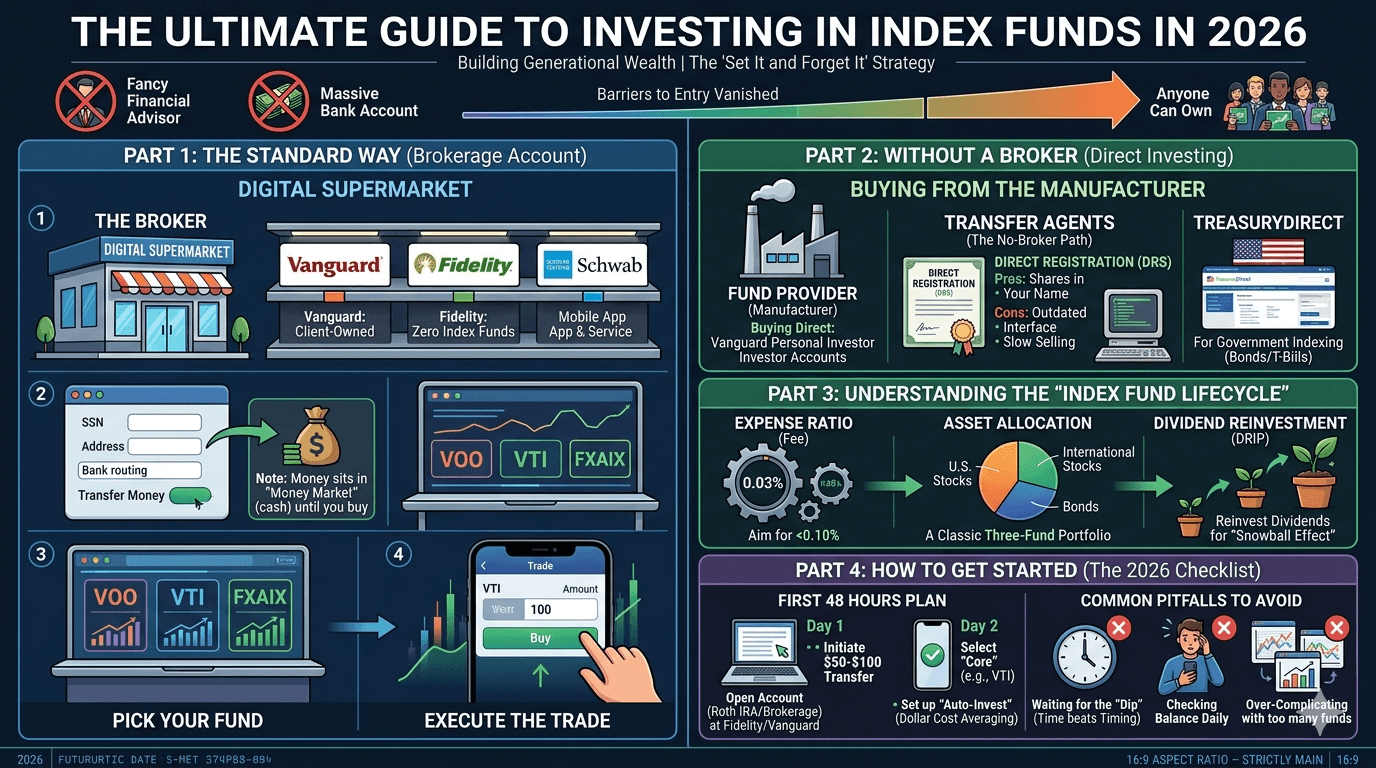
Many people believe they must use a traditional stockbroker to invest in index funds. However, modern investment platforms have made it possible to invest in index funds directly without using a broker. Investors can open accounts with fund providers, use retirement plans, or even rely on automated platforms.
In this guide, we will explain:
- What index funds are
- Why they are ideal for beginner investors
- How to invest in index funds without a broker
- A step-by-step roadmap to start investing
- Common mistakes to avoid when investing
By the end of this article, you will understand how passive investing through index funds can help build long-term financial security.
What Are Index Funds?
An index fund is a mutual fund or exchange-traded fund (ETF) designed to track the performance of a specific market index.
Instead of attempting to outperform the market through active stock picking, index funds simply aim to replicate the performance of the index they follow.
For example:
- An S&P 500 index fund tracks the 500 largest publicly traded companies in the United States.
- A Total Stock Market index fund invests in thousands of companies across multiple sectors.
- A Nasdaq-100 index fund focuses primarily on technology and growth companies.
Because index funds hold many companies at once, they provide instant diversification, which reduces risk compared to investing in individual stocks.
Why Index Funds Are Ideal for Beginners
Index funds are often recommended for beginners because they combine simplicity, diversification, and long-term growth potential.
1. Low Investment Costs
One of the biggest advantages of index funds is their low expense ratio.
Many index funds charge fees below 0.10% annually, meaning investors keep most of their profits.
Lower fees make a huge difference over time because even small fees compound over decades.
2. Built-In Diversification
When you invest in a single company, your investment performance depends entirely on that business.
Index funds spread your investment across hundreds or thousands of companies, reducing overall risk.
This makes index funds one of the safest ways to invest in the stock market.
3. Passive Investment Strategy
Unlike active trading strategies, index fund investing requires minimal effort.
Investors simply buy the fund and hold it for the long term. This approach is commonly called passive investing.
4. Strong Long-Term Returns
Historically, the U.S. stock market has produced average annual returns of roughly 7%–10% over long periods.
Index funds allow investors to capture this market growth without trying to predict which stocks will perform best.
5. Simple Portfolio Management
Index funds remove the need for complex stock analysis. Instead of managing dozens of stocks, investors can build a diversified portfolio using just a few funds.
Do You Need a Broker to Invest in Index Funds?
In the past, investors relied heavily on stockbrokers to buy and sell investments.
Today, technology has changed the investment landscape. Investors can now buy index funds directly from fund providers or automated platforms, eliminating the need for a traditional broker.
This approach can reduce fees and simplify the investment process.
Ways to Invest in Index Funds Without a Broker
There are several ways investors can purchase index funds directly.
1. Investing Directly Through Fund Providers
Many large fund companies allow investors to open accounts directly on their websites.
Popular providers include:
- Vanguard
- Fidelity
- Charles Schwab
These companies act as both the fund manager and the investment platform, allowing investors to purchase funds without using an external broker.
Steps to Invest Directly
- Visit the provider’s official website
- Open an investment account
- Link your bank account
- Transfer funds
- Purchase the index fund you prefer
This method gives investors direct control over their portfolio.
2. Investing Through Retirement Accounts
Another way to invest without a broker is through retirement accounts.
In the United States, many employers offer retirement plans such as:
- 401(k) plans
- Traditional IRAs
- Roth IRAs
These accounts often include index fund options, allowing investors to build diversified portfolios automatically.
Retirement accounts also offer tax advantages, making them an excellent option for long-term investors.
3. Using Robo-Advisors
Robo-advisors are automated investment platforms that build portfolios using index funds.
Examples include:
- Betterment
- Wealthfront
These platforms automatically allocate your investments based on your financial goals and risk tolerance.
For beginners who prefer a hands-off investment strategy, robo-advisors can be extremely useful.
4. Buying Index ETFs Through Fund Platforms
Exchange-traded funds (ETFs) are another popular way to invest in index funds.
ETFs trade on stock exchanges like individual stocks but track market indexes.
Examples include:
- VOO (S&P 500 ETF)
- VTI (Total Stock Market ETF)
- IVV (iShares S&P 500 ETF)
Many fund providers allow investors to buy these ETFs directly through their platforms.
Step-by-Step Guide to Start Investing in Index Funds
If you are new to investing, the process can seem confusing at first. The following roadmap simplifies the process.
Step 1: Define Your Financial Goals
Before investing, determine what you are saving for.
Common goals include:
- retirement savings
- buying a home
- long-term wealth accumulation
Your investment timeline will influence which index funds you choose.
Step 2: Choose the Right Index Fund
There are several categories of index funds.
S&P 500 Index Funds
These funds track the largest companies in the U.S.
Examples:
- VOO
- FXAIX
Total Stock Market Funds
These funds invest in thousands of companies across the entire market.
- VTI
- FZROX
International Index Funds
These funds invest in companies outside the United States.
- VXUS
- IXUS
Combining different types of funds helps create a balanced investment portfolio.
Step 3: Open an Investment Account
Visit a reputable fund provider and open an account.
You will typically need:
- Social Security Number
- address
- bank account details
Most accounts can be opened online in just a few minutes.
Step 4: Fund Your Account
After opening the account, transfer money from your bank.
Many platforms allow investors to start with relatively small amounts.
Some ETFs can be purchased for the price of a single share.
Step 5: Purchase the Index Fund
Search for the ticker symbol of the fund you want to buy.
- VTI
- VOO
- FXAIX
Enter the investment amount and confirm the purchase.
Step 6: Automate Your Investments
One of the best strategies for long-term investing is dollar-cost averaging.
This means investing a fixed amount regularly.
For example:
investing $100 every month
Automation helps build wealth steadily over time.
Estimate Your Investment Growth
Understanding how investments grow over time is important for planning.
You can estimate potential returns using tools like the Compound Interest Calculator on your website.
https://www.withinsecs.com/calculators/compound-interest-calculator
This tool shows how compounding returns can dramatically increase your portfolio value over long periods.
You can also explore other financial tools here:
https://www.withinsecs.com/calculators
These calculators help investors plan savings, investments, and long-term financial goals.
Example Beginner Portfolio
A simple diversified portfolio for beginners could look like this:
- 60% U.S. Total Stock Market Fund
- 20% International Stock Market Fund
- 20% Bond Index Fund
This allocation provides a balance between growth and stability.
Common Mistakes Beginners Should Avoid
While index funds are simple investments, beginners sometimes make avoidable mistakes.
Trying to Time the Market
Many new investors wait for the “perfect time” to invest.
In reality, time in the market is more important than timing the market.
Ignoring Fees
Even small fees can reduce long-term returns.
Always check the expense ratio before investing.
Selling During Market Downturns
Stock markets experience temporary declines.
Selling during market drops often locks in losses.
Long-term investors usually benefit from staying invested.
Over-Diversifying
While diversification is good, owning too many funds can complicate your portfolio.
Many investors achieve strong diversification with just two or three index funds.
Advantages of Investing Without a Broker
Investing directly without a broker offers several benefits.
Lower Fees
By avoiding brokerage commissions, investors keep more of their profits.
Direct Control
You manage your own investments without relying on intermediaries.
Simplicity
Direct investment platforms are often easier for beginners to use.
Final Thoughts
Index funds remain one of the most powerful tools for building long-term wealth. Their low fees, diversification, and passive investment strategy make them ideal for both beginners and experienced investors.
The good news is that you do not need a traditional broker to start investing. Modern platforms allow investors to purchase index funds directly from fund providers or automated investment services.
The basic process is simple:
- Define your investment goals
- Choose a low-cost index fund
- Open an investment account
- Fund the account
- Automate regular contributions
By staying consistent and focusing on long-term growth, investors can take advantage of compound returns and market growth.
If you want to estimate how your investments might grow, try the financial calculators available on:
https://www.withinsecs.com/calculators
With discipline, patience, and smart financial planning, index fund investing can become one of the most reliable paths to financial independence.
Recent Articles

Monthly Budget Planning Made Simple

Loan Early Repayment Calculator: A Smart Way to Save Money

Investment Property Calculator: A Smart Real Estate Investments Tool.